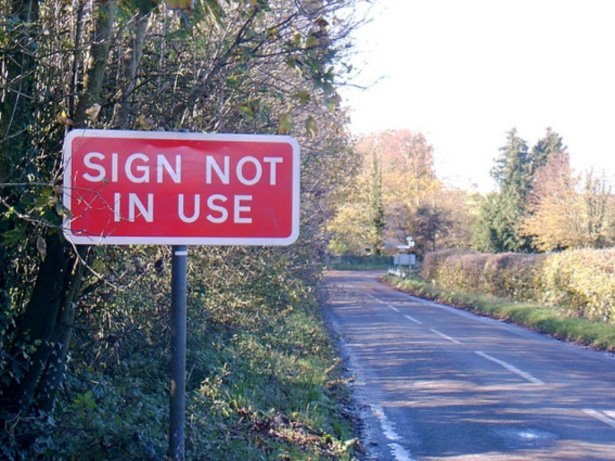
How often do you rely on signage? I know I do an awful lot. And not only because my sense of direction is close to appalling. Signs (the majority of the time) are vital. Think of being in a rush on the London Underground: you can walk pretty much non-stop from platform to platform, line to line, and as long as you look up, you’re told where to go! Think of the considerations that made this possible: type sizes, distance from individuals, height from the ground, in the eye line of each individual in all possible directions (bad examples of this do exist, of course) and around each turn and corner.
I think of signage as egoless design. The designers have to remove themselves from the outcome; they are not the important bit in this case. Signs can be some of the most simple and reductive graphic design you might see, but also some of the most challenging for a designer. Signs have to work as pretty much instant communication. You can’t very well come to a stop on the motorway, hop out and put your glasses on to see if you’re approaching the right exit for Kidderminster or not.
Jock Kinneir and Margaret Calvert are famed with being responsible for the road network signage in the UK. A particularly difficult task, as they had to communicate as much information as possible with only the room the sign allowed, and in the seconds it takes a car to pass it. This meant making decisions like using initial caps only, as this is more instantly readable than all caps.
Signage can be one of the purest forms of graphic communication, and this isn’t to say that it’s not beautiful. It’s the quintessential union of form and function.
Image credit: lemon87

Categories
The Old Bakery, 90 Camden Road
Tunbridge Wells TN1 2QP