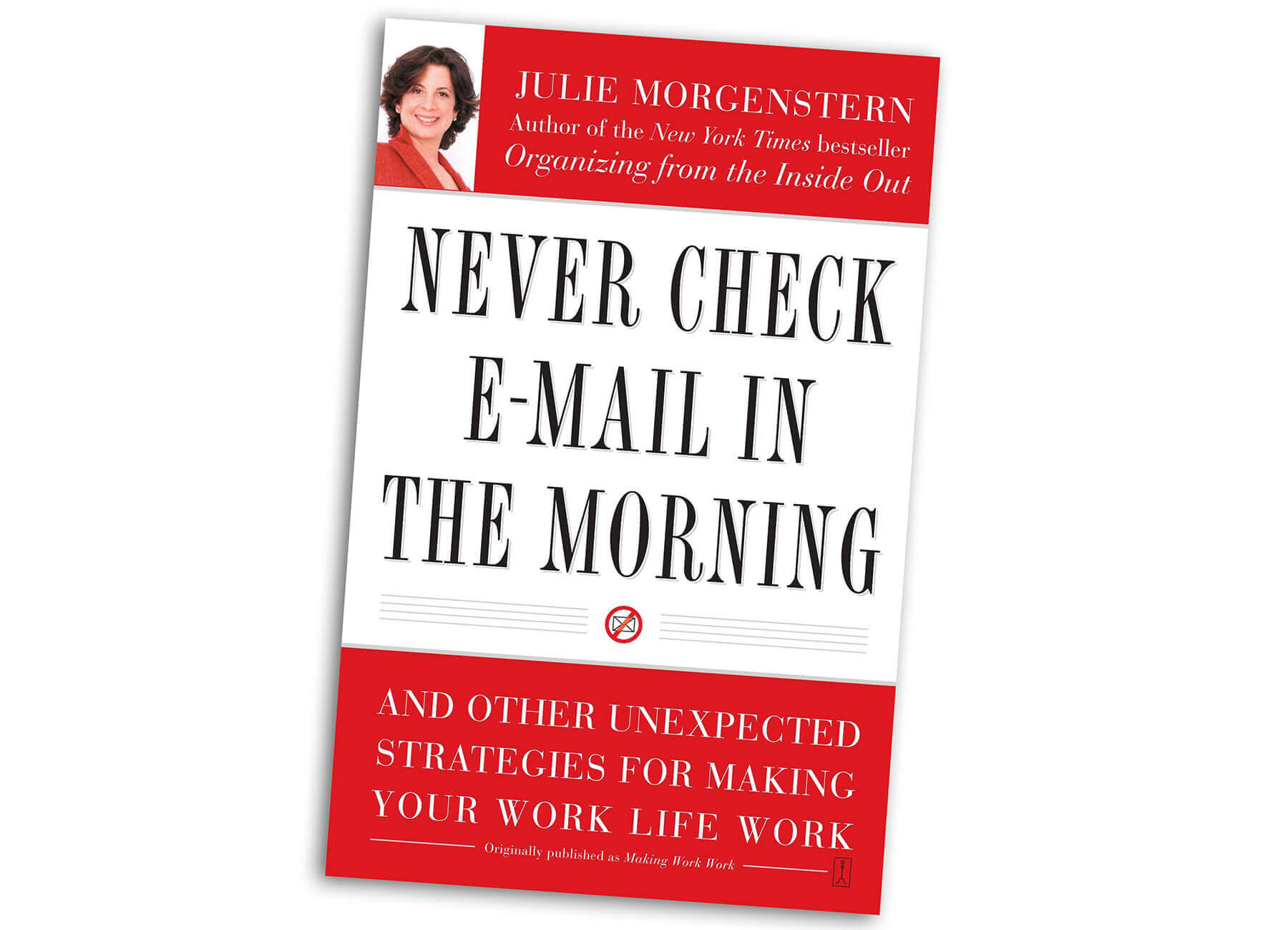
Never Check E-mail in the Morning: And Other Unexpected Strategies for Making Your Work Life Work by Julie Morgenstern.
The title of this book shows the clear mark of a publisher trying to increase sales. The former title was Making Work Work. The drawback of the new, catchier and curiosity-provoking title is that it doesn’t exactly reflect the actual advice, which is to limit your email-checking time, but in a way that suits you, whether that means only after one hour of work has been accomplished – or every other hour throughout the day.
The email-checking limit is part of an approach of classifying work tasks as Morse-code-like ‘dots’ or ‘dashes’. The dots are the emails, phone calls and even unscheduled interruptions which take a short attention span. Tasks which require longer periods of focus are the dashes. Morgenstern provides a strategy for organising the day in dots and dashes, showing examples of what could work for different people.
Personally I have shifted my working day so I prioritise the day’s projects at the beginning of the day, which only takes a few minutes, and then I try to do some ‘dash’ work for an hour before checking my emails and getting into the many other distracting (and often enticing) ‘dots’. It is amazing both how much I can get done in that ‘dash’ time and also the feeling of accomplishment of completing something that does not take very long but that I probably wouldn’t get to at all later in the day.
The dots and dashes are only one method introduced in Never Check E-mail in The Morning. Another technique Morgenstern shares for prioritising tasks is to evaluate them using three criteria: steps from the revenue line, value and time. One step from revenue includes customer service and product design; two steps are proposals, conferences and meetings and three steps include paperwork, reading and updating files.
We probably all use a similar process, even if only intuitively, when choosing among too many tasks to do in a limited amount of time (that pretty much describes every working day, doesn’t it?). Applying Morgenstern’s criteria helps clarify the process, putting it into sharper focus.
There is a wonderful proverb: Give a man a fish and he will eat for a day; teach a man to fish and he will eat for life. This is a ‘teach a man to fish’ book, which offers a variety of powerful strategies for improving productivity and effectiveness at work. Highly recommended!

Categories
The Old Bakery, 90 Camden Road
Tunbridge Wells TN1 2QP